In 2026, the opportunity is to train your team with focus: define what and how so learning delivers real impact. With constant change (AI, processes, customers, regulation), the companies that win are the ones that turn learning into a competitive advantage: fast, relevant, and measurable.
Important: these are not meant to be “the only” skills that matter, but a cross-functional core that shows up in most mid-sized and large organizations. They align with global trends and with what’s changing work the most in practice (AI, cybersecurity, collaboration, and adaptability).
Why these 10 skills?
These 10 skills are not meant to be “the only” ones, but a cross-functional core that shows up in most mid-sized and large organizations. They align with global trends and with what’s changing work the most in practice (AI, cybersecurity, collaboration, and adaptability).
We selected them using three simple criteria:
• Cross-functional: they apply to most roles (not only technical profiles).
• Performance-driven: they improve productivity, quality, service, or safety.
• Trainable and measurable: you can build them through microlearning + practice, and measure applicability and impact.
If you want references, here are three widely cited sources pointing in the same direction:
• World Economic Forum: fast-growing skills such as AI and data, cybersecurity, creative/analytical thinking, and resilience. Future of Jobs Report 2025 (digest).
• LinkedIn: AI literacy is highlighted as one of the fastest-growing skills. Skills on the Rise in 2025.
• McKinsey: in the age of AI, competitive advantage relies heavily on human capabilities such as judgment, leadership, resilience, and collaboration. Building leaders in the age of AI.
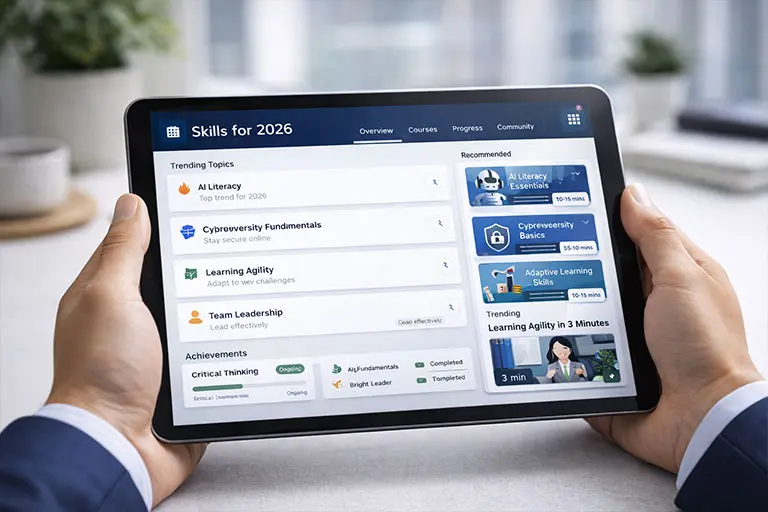
1) AI literacy
It’s not about “knowing how to code”. It’s about understanding what AI can (and can’t) do, how to ask for useful outputs, and how to use it with good judgment.
How to build it with AI: role-based practical micro-lessons (HR, sales, managers, operations) + prompt exercises in real scenarios + weekly reinforcement based on the most frequent questions.
2) Critical thinking and verification
With more information (and more AI), the risk of accepting the first answer increases. The key skill is to evaluate, cross-check, and decide.
How to build it with AI: micro-cases with “incomplete information” + verification checklists + scenario-based assessments (what would you do and why).
3) Clear communication (written and spoken) in hybrid environments
Clarity is productivity. Emails, chats, meetings… everything improves when people learn to synthesize and structure.
How to build it with AI: templates and examples by context (feedback, coordination, customer) + short practice tasks with guided correction + improvement tracking by skill.
4) Collaboration and networked working
In mid-sized and large organizations, collaboration is a skill: coordinating, sharing knowledge, and solving problems with minimal friction.
How to build it with AI: “just in time” guides for effective meetings, handoffs, and internal documentation + nudges and reinforcement based on usage behavior.
5) Personal productivity and time management
Overload isn’t solved with more tools, but with better habits: prioritization, focus, and organization.
How to build it with AI: short level-based pathways + weekly micro-challenges + adoption tracking (activation and return visits).
6) Continuous learning and learning agility
The most valuable skill: learning faster than change. It’s not about “taking courses”, but embedding learning into work.
How to build it with AI: role-adaptive pathways + recommendations based on real needs + contextual support when questions arise (flow of work).
7) Cybersecurity and digital habits
The biggest risk is often human: phishing, passwords, data, devices. The key is habits + repetition.
How to build it with AI: recurring micro-lessons (2–3 min) + simulations and reminders + measurement through fewer incidents and stronger compliance.
8) Customer orientation and experience (CX mindset)
In 2026, experience makes the difference. It’s not only customer service: every role impacts the customer (internal or external).
How to build it with AI: scenarios by sector/role + practical scripts + reinforcement based on detected friction points (repeated questions, recurring failures).
9) Team leadership (especially middle managers)
Middle managers remain the “performance multiplier”: communication, prioritization, feedback, and coaching.
How to build it with AI: micro-lessons by situation (difficult conversations, goals, motivation) + practice through cases + applicability check-ins at 7–14 days.
10) Change management and resilience
Change doesn’t stop. The ability to adapt without getting stuck is essential to sustain performance and engagement.
How to build it with AI: short pathways by moment (process, tool, or structure change) + contextual support + measurement of adoption and engagement.
How to turn these 10 skills into a real learning plan (without overwhelming anyone)
A common mistake is trying to “train everything at once”. An effective approach usually follows this order:
• Step 1: choose 3–4 priority skills per role (not based on hype).
• Step 2: build microlearning pathways (2–3 min) with spaced reinforcement over time.
• Step 3: enable support in the flow of work (when the need appears).
• Step 4: measure applicability and operational impact (not just completions).
How FIT brings it to life: catalog + adaptive AI + measurable results
At FIT Learning, we combine a practical approach with technology to scale learning intelligently:
• Course catalog: 500+ ready-to-launch courses in microlearning format—ideal for building skill- and role-based pathways.
• SmartMobile LMS: 24/7 access, personalized learning paths, engagement, and analytics to understand what works and where to reinforce.
• ADI NEX: real-time contextual support (multilingual) so learning also happens “in the moment”, when a question or need arises.
The goal is simple: train without slowing down and prove impact with data (activation, applicability, and operational outcomes).
Conclusion: in 2026, the advantage isn’t training more—it’s training better
These 10 skills provide a strong common foundation for teams that need to perform in a fast-changing environment. But the real differentiator is the method: practical microlearning, AI-driven personalization, and analytics for continuous improvement.
Do you want to define the key skills for your company and turn them into learning pathways?
At FIT, we help you prioritize skills by role, launch microlearning pathways, and measure impact with a strategy powered by AI.
Email us at fitls@fitls.com or visit fitls.com, and we’ll tailor it to your case (roles, objectives, and metrics).
