Most companies don’t have a “lack of training” problem. They have a time, priorities, and attention problem. And that’s why, when learning competes with day-to-day work, day-to-day work wins.
Microlearning has become popular as a solution… but not everything “short” works. Turning training into bite-sized pieces doesn’t guarantee impact. The key is doing it properly: with intent, with context, and with measurement.
What microlearning really is (and what it isn’t)
Microlearning isn’t “cutting a long course into little chunks”. That only turns one big problem into many small problems.
Real microlearning is learning designed to be:
• Short: typically 2–3 minutes per piece.
• Focused: one single idea or skill per micro-lesson.
• Applicable: connected to a real work situation.
• Repeatable: easy to revisit when you need it.
Why microlearning fits mid-sized and large companies
When an organization goes beyond 200 employees, clear patterns appear: distributed teams, different roles, changing processes, and a constant need to align everyone without slowing operations.
In that context, microlearning works because it fits how work happens today:
• Reduces friction: learning without “blocking the calendar”.
• Improves adoption: it’s easier to start (and come back).
• Speeds up onboarding: concrete pieces for each stage.
• Scales: same framework, role-based examples.
The myth: “microlearning = less depth”
Microlearning doesn’t replace all training. What it does is put depth where it belongs.
Think of a balanced strategy:
• Microlearning: habits, reminders, frequent situations, reinforcement, compliance.
• Longer content: certifications, deep technical training, leadership programs.
The result is a system that doesn’t rely on “one big course” to drive change, but on continuous learning that supports work.
Mobile-first: if it’s not consumed on mobile, it’s not realistic
In practice, a large part of learning happens in in-between moments: after a meeting, on the move, before a difficult conversation, during an incident.
That’s why microlearning that works is mobile-first:
• short, clear video—no endless intros.
• minimal, useful text (checklists, steps, examples).
• fast interaction (a question, a mini quiz, a decision).
• continuity: a natural “next micro-lesson” without getting lost.
How to create microlearning that actually changes behaviors
If you want microlearning to have impact (and not just be “nice content”), these 6 rules usually make the difference:
1) One micro-lesson = one objective. If you can’t summarize the outcome in one sentence, it’s too big.
2) Start with a real case. “This happens to you… what do you do?” and then you teach how.
3) Less theory, more action. Steps, examples, model phrases, common mistakes.
4) Repeat what matters over time. Reinforce at 7–14 days (what isn’t repeated gets forgotten).
5) Design by role. Same skill, different examples for sales, managers, customer service, operations.
6) Close with a useful micro-assessment. Not to “pass”, but to check understanding and application.
The differentiator in 2026: microlearning with AI
AI isn’t here to “make more content”. It’s here to make content more relevant and better distributed.
In microlearning, AI brings key advantages:
• Personalization: recommending micro-lessons based on role, needs, and behavior.
• Context: answering questions and guiding employees when the problem arises (not only beforehand).
• Optimization: identifying which pieces work, which are abandoned, and where to improve.
In short: less “same training for everyone” and more learning adapted to each team’s reality.
This approach aligns especially well with the evidence on how spaced review and active retrieval improve retention. You can explore the concept of spaced repetition and its practical application.
How to measure whether your microlearning is working
If the goal is to support the business, measuring only “views” falls short. Some metrics that actually say something:
• Activation and return visits: how many people start and come back.
• True completion (per piece): where learners drop off and why.
• Applicability: a quick question: “Have you used it this week?”
• Skill progress: evolution by competency, not by catalog.
• Operational impact: fewer errors, incidents, response times, or faster onboarding ramp-up.
When you measure well, microlearning stops being “training” and becomes a performance lever.
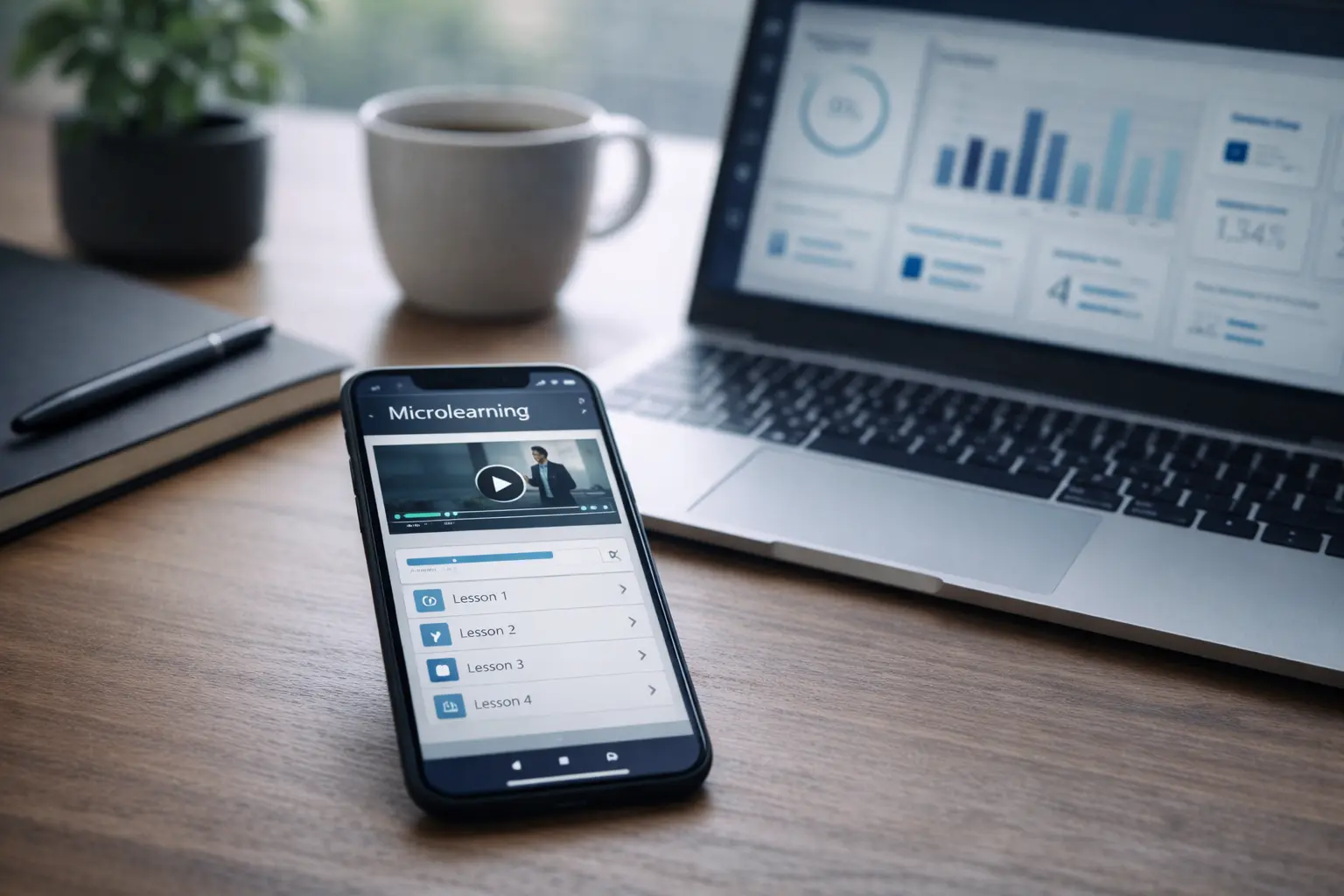
How FIT brings it to life: 2–3 min microlearning, mobile-first, and measurable
At FIT Learning, we work with microlearning as a system, not as an isolated format:
• SmartContent: creating custom micro-lessons (2–3 min) with a practical focus, instructional supervision, and multimedia production.
• SmartMobile LMS: 24/7 access, learning paths, reminders, and analytics to measure what works.
• ADI NEX: real-time contextual support so learning also happens “in the moment”, when the question or need appears.
The goal is clear: train without slowing down and prove impact with data.
Conclusion: microlearning isn’t “short”, it’s “useful”
Microlearning works when it respects the reality of the business: little time, high pressure, and the need for results. If you also design it mobile-first, connect it to real situations, and measure it with rigor, it becomes the most reliable format to scale learning today.
Do you want to implement microlearning with impact in your company?
At FIT, we help you design a microlearning strategy (2–3 minute micro-lessons, mobile-first) powered by AI and with real measurement of results: from content design to activation and follow-up.
Email us at fitls@fitls.com or visit fitls.com, and we’ll propose an approach tailored to your case (roles, objectives, and metrics).
