Corporate microlearning works when it solves a specific need in a short time and at the right moment. It is not about condensing a long course, but about designing short form training content that helps apply a skill, remember a procedure, or make the right decision without interrupting the workday.
In fast-paced companies, the question is not only what to train, but when and how to do it so that learning fits into real work. That is why microlearning should be considered part of a digital learning for companies strategy, not an isolated resource or a catalog of disconnected pieces.
When it is well designed, microlearning can support continuous training and facilitate learning in the flow of work. Its value does not depend on the length of the content, but on its relevance, clarity, and ability to activate exactly when the employee needs it.
What a useful microlearning should solve
A good microlearning starts from a single learning goal. That goal must be observable and practical: applying a rule, following a process, identifying a criterion, or responding to a common situation. If a piece tries to cover too much, it loses focus and stops being truly brief.
It is also worth distinguishing between information and performance. Not everything a team needs to know should become microlearning. This format works best when the person needs to consult, practice, or reinforce a specific skill at the moment of use.
That is why, before producing materials, it is worth checking whether the problem is one of knowledge, habit, or execution. This reading makes it possible to decide whether the microlearning should explain, remind, activate, or support a job task.

How to structure it so it does not interrupt work
The structure should be simple. A short piece can include one main idea, one applicable example, and one closing action. In many cases, a format that takes only a few minutes to consume and makes the next step clear is enough.
The design should respect the work context. If the content requires too much concentration, long screens, or complex navigation, it stops being useful for quick use. By contrast, when the experience is light and direct, the employee can access it without stopping their activity for too long.
It also helps to sequence microcontent into small connected units. This avoids turning each piece into an isolated block and makes it easier for learning to progress in stages, without overloading teams with long sessions.
Which formats usually work best
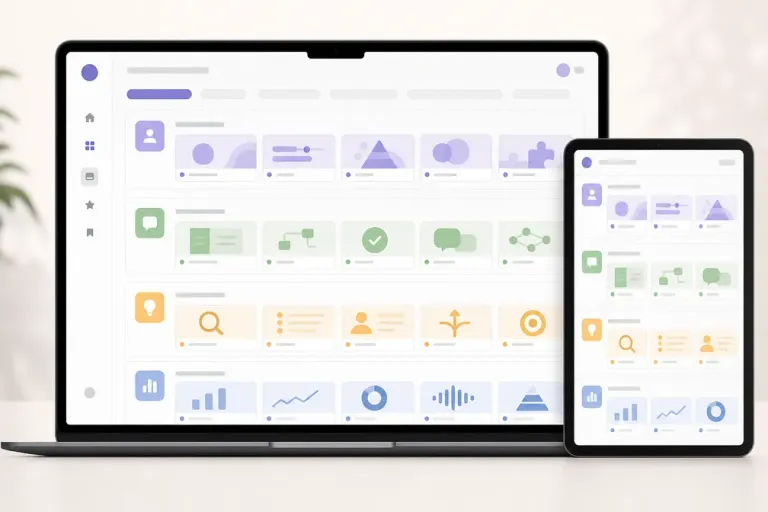
The format depends on the objective. To remember operational steps, a visual and very direct resource may be enough. To reinforce a criterion, a brief situation with a decision question may work better. To prevent repeated mistakes, a piece that shows what to do and what to avoid is often useful.
What matters is that the format does not overshadow the content. In microlearning, the form should support quick understanding, not add friction. Clean design, precise language, and clear visual hierarchy are often more valuable than complex production.
It is also worth thinking about reuse. If each piece responds to a well-defined need, it becomes easier to update it, combine it with others, and maintain a base of short form training content aligned with the company’s operations.
When to use microlearning and when not to
Microlearning is suitable for reinforcement, reminders, updates, and learning that can be applied immediately. It also fits well when it is necessary to support process changes, new tools, or recurring consultation needs.
It is not the best option when the objective requires a broad systemic view, deep reflection, or the development of several skills at once. In those cases, microlearning can be part of the journey, but not replace it.
The right decision usually depends on the type of behavior you want to provoke. If learning must translate into a very specific action, the short format may be enough. If it is necessary to build judgment, context, or complex practice, it is better to integrate it into a broader journey.
How to measure whether it truly adds value
Effective microlearning is not evaluated only by views or completions. What matters is whether it helps the team remember better, make fewer mistakes, or apply a criterion or procedure sooner. That assessment requires linking the content to a real operational need.
It is also worth reviewing usage frequency and consumption time. If a piece is consulted exactly when a doubt or critical task arises, its practical value is greater than that of content consumed in isolation and without context.
Measurement should be simple and useful for decision-making. If a piece is not consulted, is consulted too late, or does not help resolve the expected situation, it probably needs adjustments in format, objective, or placement within the workflow.
Microlearning, technology and support for scaling
To scale this approach across an organization, you need a technological base that makes access, updating, and distribution of content easier. If access is inconvenient, microlearning loses its main advantage: being available at the exact moment.
It also helps to have a consistent design logic. When the pieces follow common criteria, teams better understand what to expect from each piece of content, and it becomes easier to maintain pedagogical consistency across the library.
In that context, solutions such as SmartMobile and ADI Nex can support the creation and consumption of digital learning for companies, always within a well-defined strategy focused on practice. FIT Learning Systems works precisely on this kind of approach: microlearning and custom courses designed to integrate into daily activity without losing training focus.
