In many organizations, the problem is not a lack of content, but its dispersion. There are documents, presentations, manuals, and internal resources that contain useful knowledge, but they are not always organized to become training. SmartContent starts precisely from that reality: helping transform existing materials into clearer, more reusable, and easier-to-maintain digital content.
When a company needs to train different teams, at different times, and with changing needs, the format matters as much as the message. Storing information is not enough. It needs to be structured so it can be updated without redoing all the work, adapted to different profiles, and kept consistent over time.
That is why talking about SmartContent is not just talking about technology. It is also about method. About how knowledge is organized so it stops depending on isolated pieces and becomes part of a more stable and scalable training base.

From a loose document to training content
In many companies, the starting point is a file. It may be a sales guide, an internal procedure, a policy, or a technical dossier. That material already contains valuable information, but it is not always ready for learning. That is where the SmartContent approach comes in: reviewing, organizing, and turning that content into a comprehensible training experience.
The value is not only in digitizing. It lies in deciding which part of the content should be explained, which should be summarized, and which needs a more didactic sequence. That transition allows knowledge to stop living in a single format and become part of learning paths that are more useful for the company.
This step also reduces duplication. When the same content is reused in different courses or modules, the organization works with a more consistent base. If one part of the message changes, there is no need to redo everything from scratch; it is enough to update the common core and distribute it where it belongs.
A logic designed for better updating
One of the usual challenges in corporate training is keeping content up to date. Processes change, tools change, and in some cases business priorities change too. If the structure is not well designed, every update becomes a long and inefficient task.
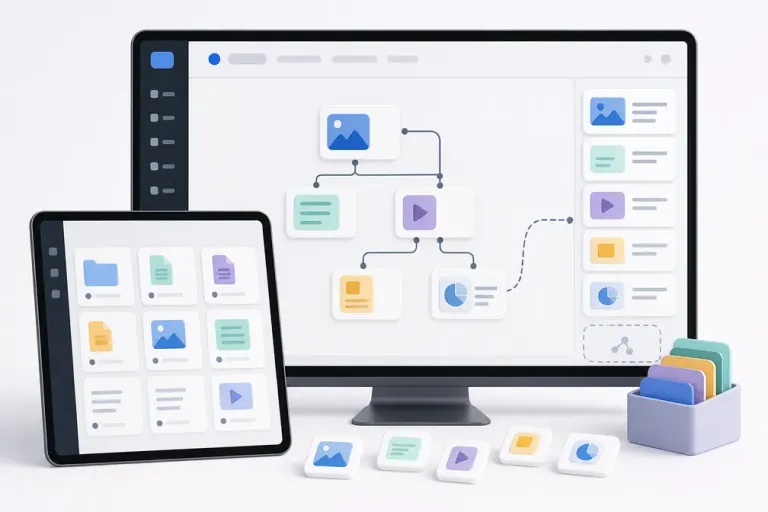
SmartContent responds to that need with a more modular logic. Instead of relying on a single closed block, content can be organized into parts that are easier to review. That helps control versions more effectively and maintain the quality of the material without increasing the operational burden.
This way of working is especially useful when several teams take part in creating or validating content. The clearer the structure, the easier it is to maintain common criteria and avoid inconsistencies between courses, support materials, and internal communications.
Reuse without losing context
Reusing content does not mean copying and pasting without criteria. It means identifying which elements can work in more than one training path and adapting them with purpose. The same block can serve as an introduction, reminder, or reinforcement, as long as it is properly contextualized for each audience.
That approach is especially useful in environments with different areas, roles, or experience levels. The knowledge base is used better when it is designed from the start to be flexible. In this way, the same material can support different learning actions without forcing the creation of completely new versions for each case.
In addition, well-planned reuse helps reinforce pedagogical consistency. If the organization uses a common language, a recognizable structure, and a uniform criterion, teams receive a clearer and less fragmented experience.
What it brings to team work
In a business context, team time always matters. That is why any content system that simplifies production, review, and distribution has a direct impact on operations. SmartContent aims at that efficiency without losing sight of learning quality.
When content is better organized, coordination effort is reduced. It also improves traceability of what is published, corrected, or reused. This not only makes internal management easier, but also makes it simpler to respond to new training needs without starting from zero.
In practice, the benefit lies in being able to work with a more organized, more flexible, and easier-to-maintain base. That allows training to better support the company when the business, the product, or the operational context changes.
A useful base to scale with criteria
Scaling content should not mean losing control. On the contrary: the more digital training grows, the more important it becomes to have a clear structure. SmartContent fits that need because it facilitates a more orderly management of training knowledge, especially when many materials need to be produced, adapted, and maintained at the same time.
The final goal is not to have more content, but better content. Materials that can be updated with less friction, reused logically, and remain useful as the organization grows. That is the foundation for building more sustainable digital training over time.
In the case of FIT Learning Systems, this approach aligns with a way of working focused on digital training for companies, combining SmartMobile, ADI Nex, and custom developments when the project requires it.
