How to turn internal knowledge into useful answers with AI
Organizational knowledge becomes more valuable when people can find it, understand it and use it exactly when they need it.
Procedures, manuals, policies, technical documentation, FAQs, training materials and expert knowledge are all part of a major internal asset. Artificial intelligence opens up new possibilities for making that knowledge much more accessible.
The shift is simple: moving from searching for information to being able to interact with it.
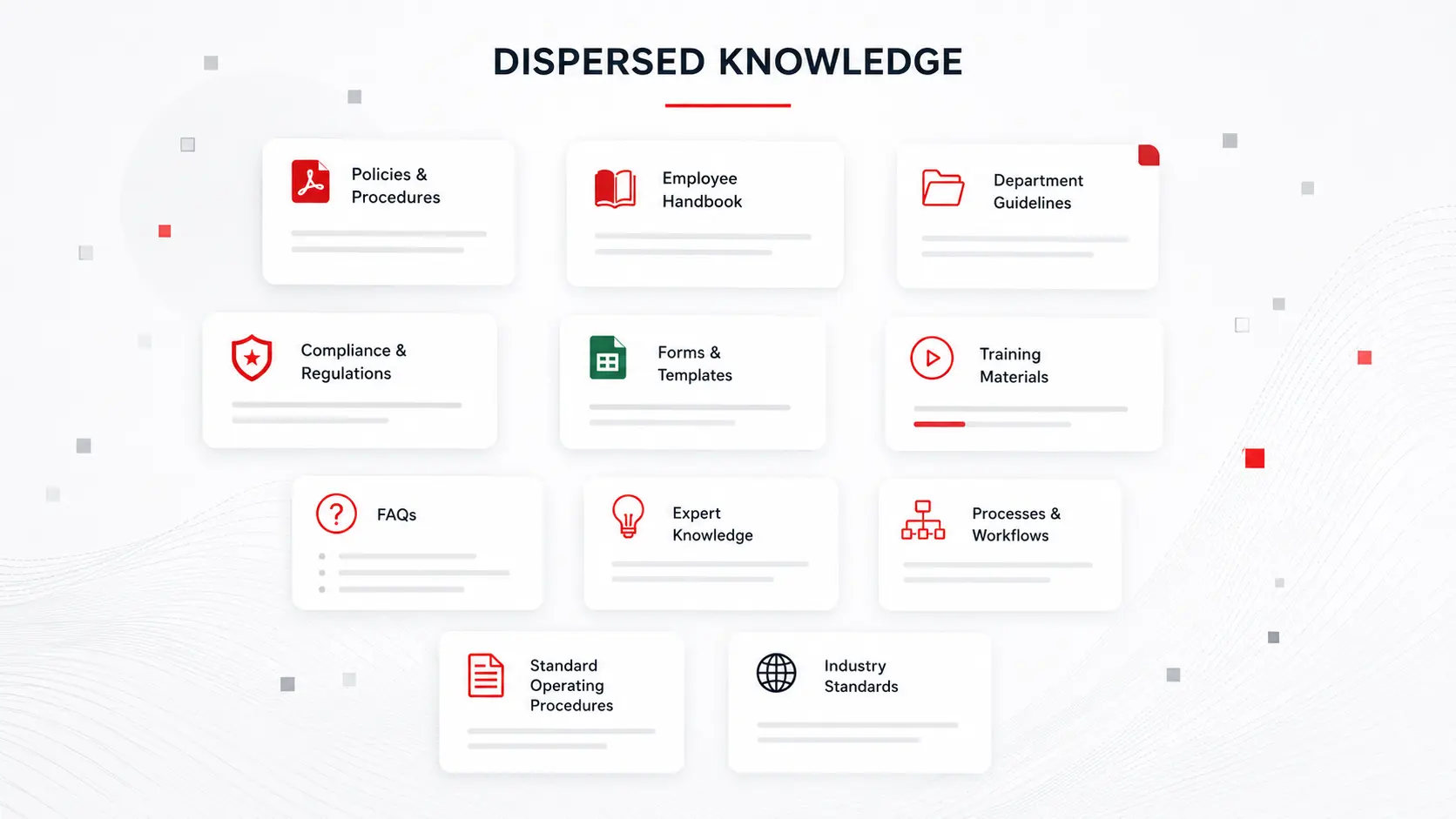
The knowledge already exists: the key is making it accessible
Many companies have accumulated large volumes of documentation over the years.
Some of it is stored in learning platforms. Other information lives in intranets, shared folders, manuals, document repositories or internal tools.
In addition, a significant amount of knowledge lives within people themselves.
When all that information can be organized and consulted easily, it becomes a much more useful resource for everyday work.
Generative AI can create a new layer of access: people can ask a question in natural language and receive an answer built from the information available and validated by the organization.
From searching documents to asking questions
Imagine a common situation.
An employee needs to know which procedure to follow when an incident occurs.
The traditional approach is to locate the right document, open it, find the relevant section and identify the answer.
With an AI-powered conversational layer, the interaction can be much more direct.
For example:
- What steps should I follow if this incident occurs?
- Where can I find the latest version of the procedure?
- Which documents do I need?
- Which rule applies in this case?
The technology can identify the relevant content and provide a contextual answer.
The knowledge remains the same. What changes is the way people access it.
Answers that take context into account
One of the major opportunities of AI applied to corporate knowledge is the ability to provide answers adapted to a specific query.
The same documentation can respond to many different questions.
For example:
- Which documents do I need for this process?
- What is the current protocol?
- What should I do in this case?
- Where can I find this form?
- Which rule applies to this situation?
- What are the steps in this procedure?
Natural language makes information closer to the way people actually express their questions.
This helps make knowledge easier to consult for employees with different levels of experience.
Especially useful during onboarding
The first few weeks in an organization generate many questions.
People need to understand processes, tools, policies, internal vocabulary and ways of working.
An AI-based knowledge consultation system can complement the onboarding pathway by providing access to information when specific questions arise.
Structured training provides the learning journey.
Conversational access to knowledge provides support at the moment of need.
Both can be part of the same learning experience.
Also useful for compliance and internal procedures
The same approach is particularly valuable in areas where policies, regulations or procedures need to be consulted frequently.
For example:
- compliance;
- data protection;
- security;
- risk prevention;
- internal policies;
- operational procedures;
- technical documentation.
An employee can ask a direct question and access an answer based on the documentation the organization has incorporated into the system.
In addition, when content is updated, those changes can be reflected in the information available to users.
Learning continues after the course
Corporate learning increasingly happens at different moments.
There are moments for taking a course.
Moments for practicing.
Moments for assessment.
And moments for consultation.
A question that arises while performing a task can become a learning opportunity.
If someone can access an explanation, procedure or resource at that exact moment, knowledge becomes directly connected to a real need.
For this reason, access to knowledge can complement structured training and extend learning support beyond a specific course or activity.
Expert knowledge can also scale
In many organizations, certain people hold a large amount of specialist knowledge.
They are professionals who know a product, procedure, regulation or problem-solving approach in depth.
That knowledge often appears in documents, presentations, training materials or repeated answers to questions from colleagues.
Organizing it allows more people to access it.
It can also reduce the need to locate the same expert every time a recurring question appears.
The expert remains essential for providing judgment, updating content and validating information.
Technology helps distribute that knowledge more effectively.
The importance of information quality
A good AI experience depends directly on the quality of the knowledge behind it.
For that reason, it is important to work with content that is:
- up to date;
- relevant;
- well structured;
- validated;
- adapted to the organization’s context.
AI can make access significantly easier, but corporate knowledge remains the foundation.
The better the information is organized and maintained, the more value the consultation experience can provide.
A multilingual experience
In international organizations, language can become another barrier to accessing knowledge.
Generative AI can support queries and responses in different languages, making the same knowledge base more accessible to teams distributed across different countries.
This can be particularly useful for organizations with global procedures, shared documentation or international teams.
The goal is to make knowledge accessible regardless of where the person is located or the language used to make the query.
Understanding what people need to know
User questions can also provide valuable information.
They help organizations understand which topics generate the most uncertainty, which procedures are consulted most frequently and where potential knowledge gaps may exist.
This analysis can inform future learning decisions.
For example:
- create new content;
- reinforce an explanation;
- update a procedure;
- design a microlearning capsule;
- add a frequently asked question;
- identify an emerging learning need.
In this way, knowledge consultation can also contribute to the continuous improvement of the learning ecosystem.
How we approach it at FIT with ADI NEX
At FIT, we developed ADI NEX to facilitate a more direct relationship between people and their organization’s knowledge.
ADI NEX uses generative intelligence to support natural-language queries and provide contextual answers based on the content incorporated by each company.
It can work with internal documentation, learning materials, procedures, regulations and other knowledge resources.
It can also adapt visually to each organization’s identity and be used as a dedicated web experience or integrated into other digital environments through an embedded button.
Its approach makes it possible to use the same knowledge base across different contexts:
- onboarding;
- continuous learning;
- technical support;
- internal documentation;
- procedures;
- regulations;
- corporate knowledge consultation.
The idea is simple: make finding knowledge as natural as asking a question.
From content to accessible knowledge
Artificial intelligence is opening a new stage in corporate knowledge management.
Content remains essential.
What changes is the experience: that content can now become accessible, contextual answers available at the moment a need arises.
This makes it possible to connect documentation, training and support in a way that is much closer to everyday work.
The future of corporate learning also moves in this direction: creating high-quality knowledge and making sure it reaches each person exactly when they can use it.
